Problem
When normal heartbeats dominate a dataset, a model can achieve high accuracy while missing rare classes. Our four-person team compared five PyTorch architectures using macro F1 alongside accuracy to examine when additional model complexity actually helps.
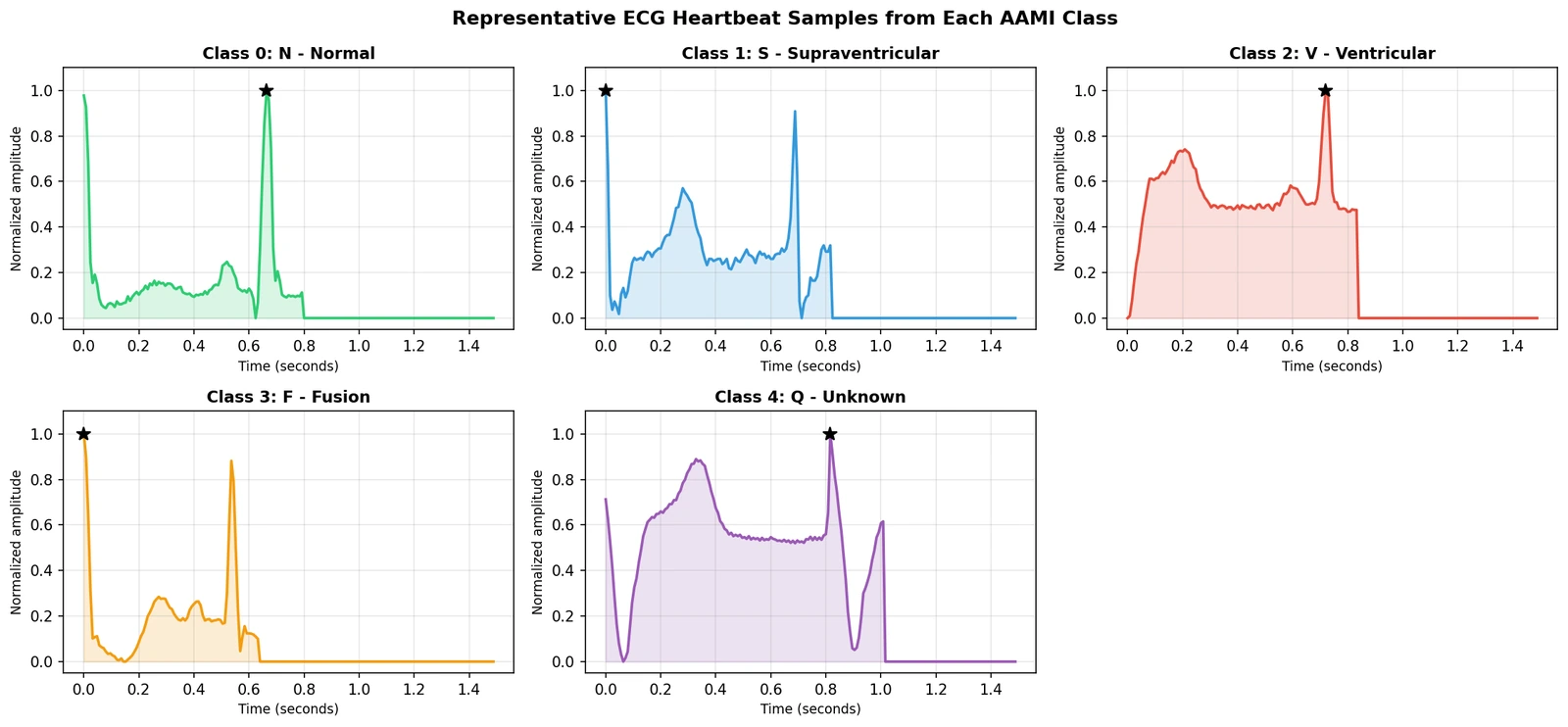
The preprocessed MIT-BIH benchmark provides single-channel, 187-value heartbeat segments labeled N, S, V, F and Q. This is an offline classification study, not a diagnostic system deployed on a wearable device.
Architectures and experiments
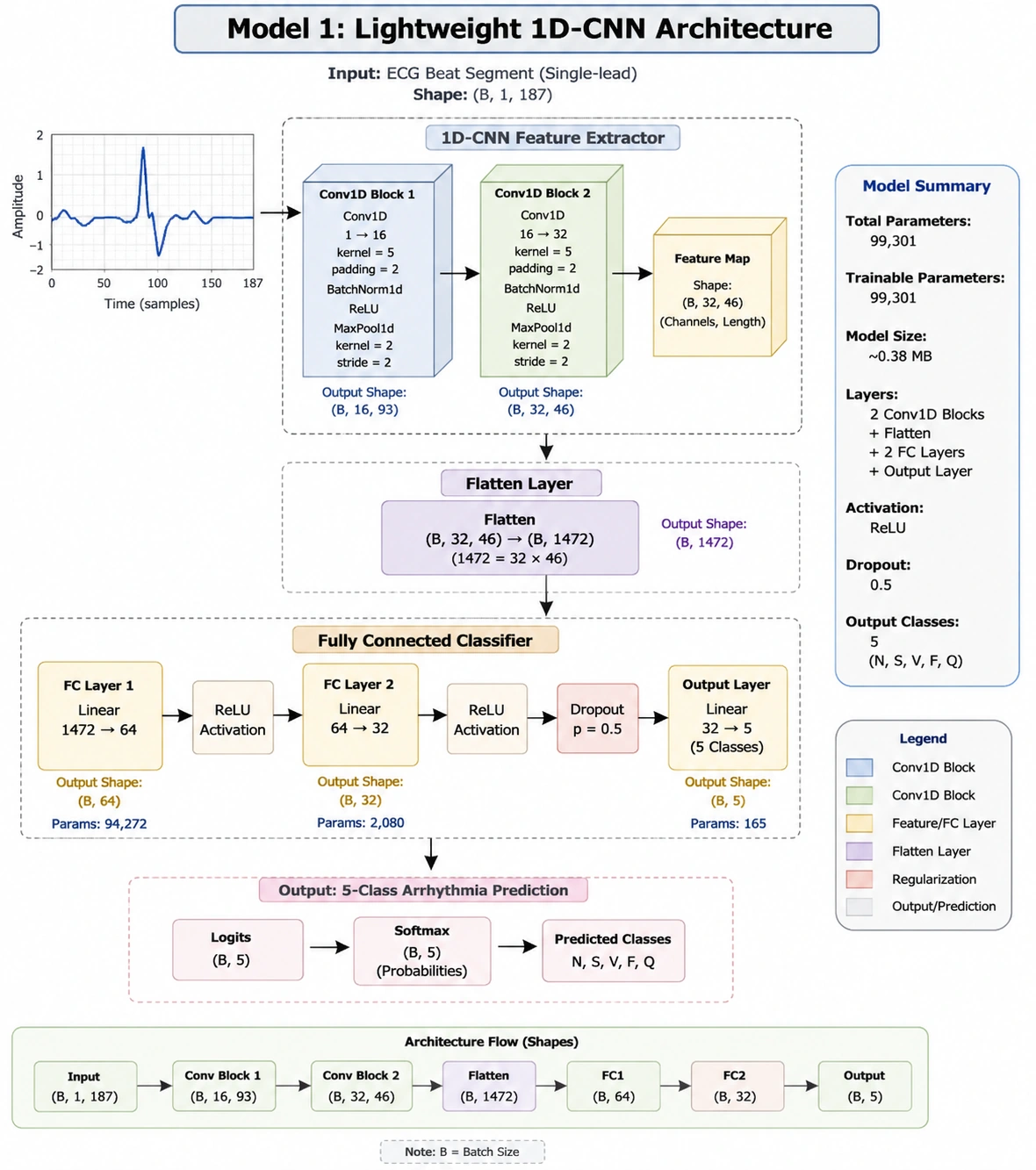
- 1D-CNN: Conv1D, BatchNorm, pooling and a dense classifier.
- CNN-BiLSTM: local CNN features combined with bidirectional sequence modeling.
- CNN-CBAM-BiLSTM: a hybrid with channel and spatial attention.
- MAB-Net: depthwise separable convolution, SE attention and BiLSTM.
- CAT-Net: CNN features, channel attention and a Transformer encoder.
Custom nn.Module and Dataset subclasses implement model behavior and data loading. Attention and convolution blocks are composed into larger networks. Training uses weighted CrossEntropy, dropout, early stopping and checkpoints. One-factor-at-a-time experiments vary individual hyperparameters while holding others fixed.
Results
| Configuration | Test accuracy | Macro F1 |
|---|---|---|
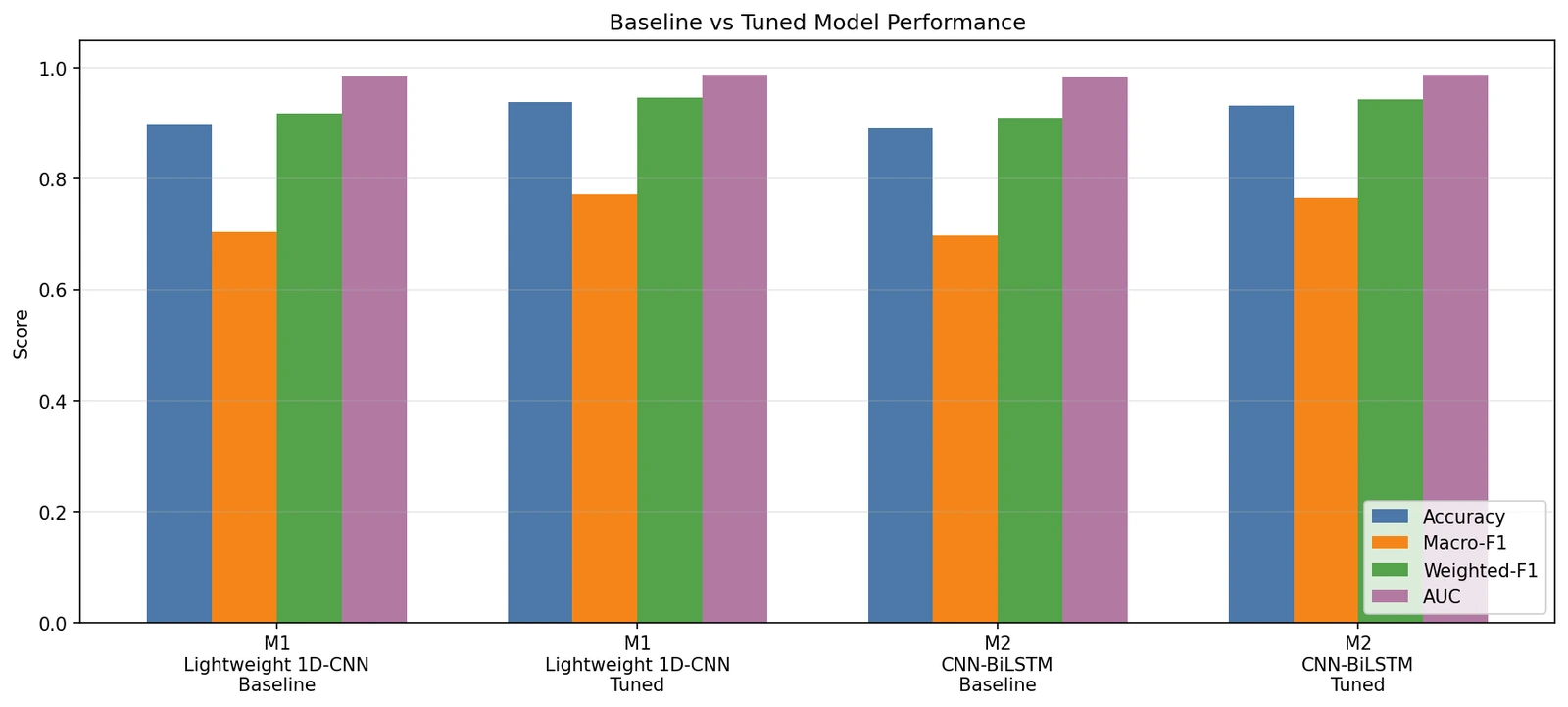
| Tuned 1D-CNN | 93.89% | 0.7719 |
| Tuned CNN-BiLSTM | 93.23% | 0.7664 |
| CNN-CBAM-BiLSTM | 85.92% | 0.6536 |
| MAB-Net baseline | 93.70% | 0.7906 |
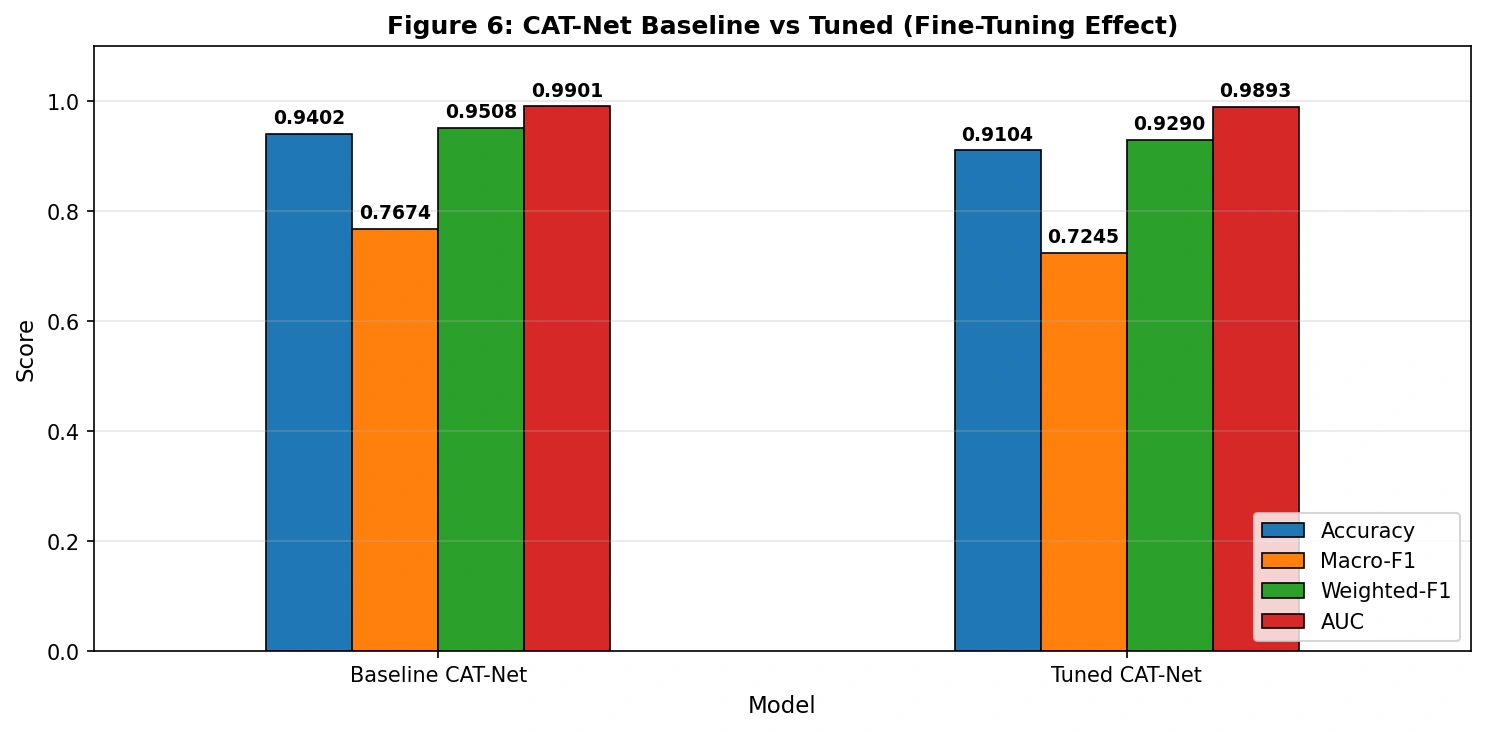
| CAT-Net baseline | 94.02% | 0.7674 |
These are team results from the report and saved notebook outputs. MAB-Net leads on macro F1 while CAT-Net leads on accuracy. Tuned CAT-Net falls to 0.7245 macro F1, illustrating that individually promising hyperparameters do not necessarily combine well.
Limitations and findings
Model 3 uses random_split rather than the stratified split in the other notebooks. The comparison should be repeated with identical partitions. Patient-level validation and actual on-device latency/energy measurements are also absent.
The models classify current heartbeat segments rather than forecasting future events. The key finding is that model choice needs accuracy, minority-class performance and parameter count together; additional attention complexity did not consistently improve results in these experiments.